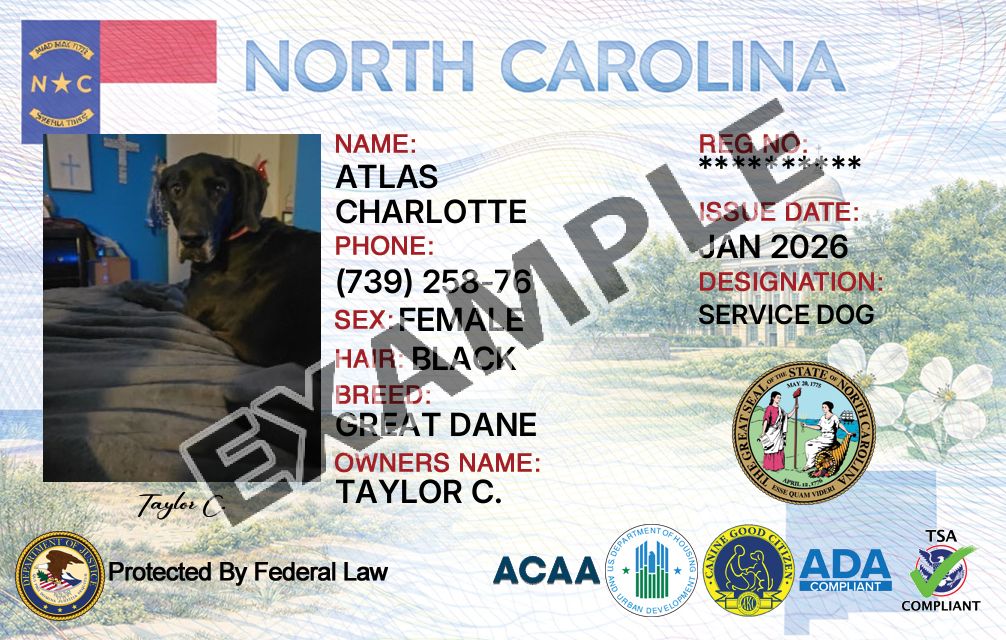
Registering Your Dog Locally in Columbus County, North Carolina
If you’re searching where do i register my dog in Columbus County, North Carolina for my service dog or emotional support dog, the most important thing to know is that there usually isn’t a single statewide “service dog registry” or “ESA registry” that replaces local rules. In practice, what most residents mean by “register” is one (or more) of the following: a dog license in Columbus County, North Carolina (when required locally), rabies vaccination compliance, and/or updating your dog’s identifying information in local animal control records.
Important: “Licensing” vs. “Service Dog/ESA” Status
A local dog license (or rabies tag record) is different from a dog’s legal status as a service dog and different from an emotional support animal. Service dogs and ESAs are not “licensed” by a vendor or online registry in a way that overrides local animal control and rabies rules. If you live inside a city/town in Columbus County, you may also have city-level requirements in addition to county rules.
Where to Register or License Your Dog in Columbus County, North Carolina
Because dog licensing and rabies enforcement are typically handled locally, start with county animal control and your local city office (if you live inside city limits). Below are example official offices within Columbus County, North Carolina that may help with an animal control dog license Columbus County, North Carolina question, rabies compliance, bite reporting, and local ordinances.
County Animal Control / Animal Services (Primary Starting Point)
Columbus County Animal Control
Address: 288 Legion Drive
City: Whiteville
State: NC
ZIP: 28472
Phone: (910) 641-3945
Office hours: Not listed on the source provided
Email: Not listed on the source provided
Tip: Ask whether your address is in an incorporated town/city (with its own animal services rules) and what proof they accept for rabies compliance.
Rabies & Public Health (Bites, Exposure, Documentation Questions)
Columbus County Health Department
Address: 810 Pinckney St
City: Whiteville
State: NC
ZIP: 28472
Phone: (910) 640-6615
Office hours: Monday–Friday 8:00am–5:00pm
Email: Not listed on the source provided
For dog bites or rabies exposure guidance, your local health department is often involved in public health reporting and follow-up.
City-Level Animal Services (If You Live Inside City Limits)
City of Whiteville Animal Services
Address: 317 S. Madison Street
City: Whiteville
State: NC
ZIP: 28472
Phone: (910) 642-8046
Office hours: Not listed on the source provided
Email: Not listed on the source provided
If your home is inside Whiteville city limits, ask whether the city requires a separate license, tag, or registration beyond county rabies compliance.
Overview of Dog Licensing in Columbus County, North Carolina
What “Dog Registration” Usually Means
In many North Carolina communities, “registering” a dog is tied to rabies vaccination enforcement and local animal control rules. Depending on where you live in the county, you might encounter:
- A local dog license in Columbus County, North Carolina (county or municipal), which may involve a fee, a tag, or an annual renewal.
- A rabies tag and vaccination certificate issued by your veterinarian, which is often the key document animal control asks for.
- A local record with Animal Control for enforcement, bite investigations, stray pickup/return, and complaint follow-up.
Why “Most Licensing Is Handled Locally”
There isn’t one universal, statewide “dog licensing office” that handles every resident’s needs. Instead, the process is typically handled by your county animal control and/or your town or city. That’s why searches like where to register a dog in Columbus County, North Carolina often lead to a list of local offices rather than a single registry.
Rabies Vaccination Requirements (What to Expect)
While exact procedures can vary by locality, rabies vaccination is a core requirement that comes up in nearly every licensing or enforcement scenario. If animal control or a city office asks for “proof,” it commonly means your veterinarian’s rabies certificate (and sometimes the tag number). If your dog is involved in a bite report or possible exposure, public health may also become involved.
How Dog Licensing Works Locally in Columbus County, North Carolina
Step 1: Confirm Whether You’re in a City/Town or Unincorporated County
Start by identifying whether your address is inside the limits of a municipality (for example, the City of Whiteville) or in unincorporated Columbus County. This matters because a city may have its own animal services department, ordinances, and licensing approach, while the county animal control typically handles countywide enforcement and services for unincorporated areas.
Step 2: Gather the Usual Documents
When you contact animal control or a city office, they may ask for basic documentation to issue or update a local record or to confirm compliance. Even if you are calling about a service dog or emotional support animal, these local requirements often still apply.
Step 3: Ask the Right Question (So You Get the Right Answer)
To avoid confusion, be specific when you call. Example questions that help:
- “Do you issue a local license tag, or do you only require rabies vaccination proof?”
- “If I live inside city limits, do I need a city license as well as county compliance?”
- “What documentation do you accept for rabies vaccination proof?”
- “If my dog is a service dog, do any fees or rules change locally?”
Step 4: Understand Enforcement vs. Identification
A license or local registration is usually about local compliance and identification (helping return a lost dog, proving vaccination status, and supporting animal control enforcement). It does not “certify” training, temperament, or disability-related task work for service dogs, and it does not establish housing rights for ESAs.
Service Dog Laws in Columbus County, North Carolina
What Makes a Dog a Service Dog (In Plain Terms)
A service dog is generally understood as a dog trained to perform specific tasks for a person with a disability. The “legal status” comes from the dog’s trained work and the handler’s disability-related need—not from buying an ID card, vest, or online registration.
Do Service Dogs Need a Local Dog License?
Often, yes: service dogs typically still must follow local animal control and rabies vaccination rules where the handler lives. In other words, if you are trying to figure out an animal control dog license Columbus County, North Carolina question, your service dog may be subject to the same rabies compliance requirements as any other dog. Any exemptions or reduced fees (if offered) are handled locally and should be confirmed directly with the office you contact.
Public Access: What Local Licensing Does (and Doesn’t) Change
Local licensing can help with identification and compliance, but it does not change the basic expectations for service dogs in public places. A service dog should be under control and housebroken. If a business asks about your dog, service dog rules are not based on “registration papers.”
Emotional Support Animal Rules in Columbus County, North Carolina
What an Emotional Support Animal (ESA) Is
An emotional support animal provides comfort by its presence, but it is not the same as a trained service dog that performs disability-related tasks. Many people search for “ESA registration,” but in real life, local animal control offices generally focus on public health and local ordinances (like rabies compliance), not on labeling an animal as an ESA.
Do ESAs Get Special Treatment for Dog Licensing?
Usually, an ESA is treated like any other pet for local animal control purposes—meaning rabies vaccination requirements and any local licensing rules still apply. If you’re asking where to register a dog in Columbus County, North Carolina for an ESA, the answer is typically the same offices you’d contact for any dog: county animal control and (if applicable) your city animal services department.
Housing vs. Public Access
ESAs are commonly discussed in the context of housing accommodations, not public access. A local dog license does not, by itself, create ESA housing rights, and an ESA label does not replace local animal control rules.
Frequently Asked Questions
Start with Columbus County Animal Control (county-level) and, if you live inside a municipality, also check with your city animal services. These offices can tell you whether your area issues a license tag, relies on rabies documentation, or has other local requirements.
Not always. A rabies tag typically comes from your veterinarian after vaccination, while a local license (if issued) is a county or city requirement. Some areas treat rabies compliance as the primary “registration” requirement, while others may also issue a separate local license tag. Call the local office to confirm what applies to your address.
Generally, no. Service dog status is based on training and disability-related task work, and ESA status is typically discussed in the context of housing accommodations. Neither is usually established by an online registry for local compliance purposes. For local rules (like rabies requirements and any licensing), contact the county/city offices listed above.
Contact Columbus County Animal Control for animal control enforcement and local procedures, and contact the Columbus County Health Department for public health guidance related to rabies exposure or follow-up.
Use a short, clear script so staff can route you correctly:
“Hi—my address is in Columbus County near (your town/community). I’m trying to confirm local requirements for a dog license and rabies compliance. Do you issue a local license/tag here, and what documents and fees apply? Also, I have a service dog / emotional support animal—does anything change locally?”